ACA100 Valid Practice Questions, Learning ACA100 Materials
Wiki Article
BTW, DOWNLOAD part of PracticeVCE ACA100 dumps from Cloud Storage: https://drive.google.com/open?id=1dFYJEDtnhHtaaFqqgy58P-VLLJzbI_C9
Candidates who are preparing for the Appian exam suffer greatly in their search for preparation material. You won't need anything else if you prepare for the exam with our Appian ACA100 Exam Questions. Our experts have prepared Appian Certified Analyst with dumps questions that will eliminate your chances of failing the exam.
Appian ACA100 Exam copyright Topics:
| Topic | Details |
|---|---|
| Topic 1 |
|
| Topic 2 |
|
| Topic 3 |
|
| Topic 4 |
|
| Topic 5 |
|
>> ACA100 Valid Practice Questions <<
ACA100 Valid Practice Questions Makes Passing Appian Certified Analyst More Convenient
With pass rate reaching 96%, our ACA100 exam materials have gained popularity in the market, and many candidates choose us for this reason. We can help you copyright just one time. What’s more, ACA100 exam materials are high quality, and you can improve your efficiency by using them. You can receive your downloading link and password within ten minutes after payment, so that you can start your learning by using ACA100 Exam Dumps. Free update for one year is available, and our system will send the latest version to your email automatically, you just need to check your email for the latest version.
Appian Certified Analyst Sample Questions (Q53-Q58):
NEW QUESTION # 53
This user story's development has been completed and meets the acceptance criteria:
"As a customer, I would like to receive a text message when my order is ready to be picked up." What is the status of this user story?
- A. Open
- B. Ready for quality assurance (QA)
- C. Done
- D. Ready for Development
Answer: B
Explanation:
The correct status is Ready for quality assurance (QA) because the scenario states that development has been completed and the story meets the acceptance criteria, but it does not state that the story has passed QA validation, user acceptance, product owner acceptance, or the team's full Definition of Done. In Agile delivery, acceptance criteria guide development and provide the basis for testing, but satisfying them during development does not automatically close the story. After implementation, the story must move into a validation stage where QA confirms that the delivered behavior matches the expected business outcome and does not introduce defects or regressions.
Done would be appropriate only when the story has completed all required review, testing, acceptance, and completion standards. Open applies before work has meaningfully progressed. Ready for Development applies when the story has been refined, estimated, prioritized, and is prepared for implementation, but coding
/configuration has not yet been completed. Since the prompt explicitly says development is complete, the next lifecycle state is QA readiness.
Reference topics: User Story Lifecycle, Acceptance Criteria, Definition of Ready, Definition of Done, Agile Delivery, Quality Assurance.
NEW QUESTION # 54
Which Appian gateway node can only trigger a single outgoing path?
- A. COMPLEX
- B. XOR
- C. OR
- D. AND
Answer: B
NEW QUESTION # 55
An organization wants to automate identification of its dissatisfied customers based on the ticket description and assign the appropriate team to provide a quick resolution.
What is the best way to auto-classify the dissatisfied customers as part of processing?
- A. Using a decision table
- B. Using a natural language connected system
- C. Using an image analysis connected system
- D. Using a SAIL form
Answer: B
Explanation:
The organization aims to automate the identification of dissatisfied customers based on the ticket description.
To achieve this, leveraging natural language processing (NLP) capabilities is the most efficient method.
Appian provides connected systems that allow integration with external NLP services. These services can analyze text data (such as ticket descriptions) to determine the sentiment or classify the text into predefined categories (like " dissatisfied customer " ).
* Natural Language Connected System :
* Appian can integrate with third-party NLP platforms such as Google Cloud Natural Language, AWS Comprehend, or Azure Text Analytics via connected systems.
* These services analyze the text provided in the ticket description to detect sentiment, keywords, or specific categories indicating dissatisfaction.
* Based on the analysis, the system can automatically assign the appropriate team to handle the case.
* Why Not Other Options? :
* B. Decision Table : While decision tables are useful for rule-based decisions, they are not suitable for interpreting unstructured text like ticket descriptions.
* C. Image Analysis Connected System : This option is irrelevant as the task involves text processing, not image analysis.
* D. SAIL Form : SAIL forms are primarily used for user interface creation and are not intended for text analysis or classification.
* Implementation in Appian :
* Create a connected system to integrate with the chosen NLP service.
* Configure the NLP service to analyze the text data and return the sentiment or classification results.
* Based on the results, use process models to route the ticket to the appropriate team for resolution.
:
Appian Documentation on Connected Systems: Appian Connected Systems
Appian Community Success Guide: Appian Delivery Methodology
Third-Party NLP Services Integration: Google Cloud NLP Documentation
NEW QUESTION # 56
Match the Appian gateway types to the appropriate descriptions. Each gateway type will be used once.
Note: To change your responses, you may deselect your response by clicking the blank space at the top of the selection list.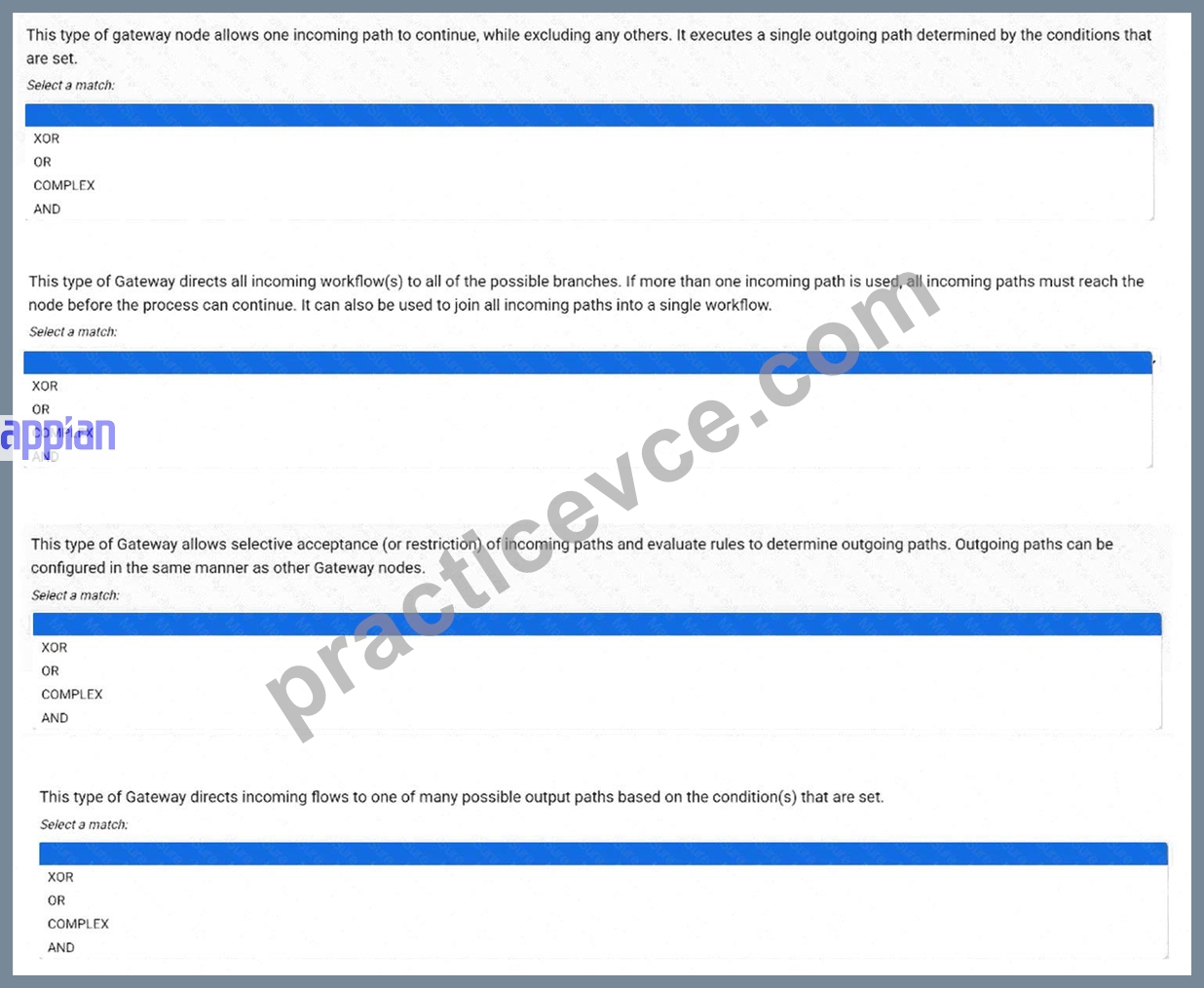
Answer:
Explanation: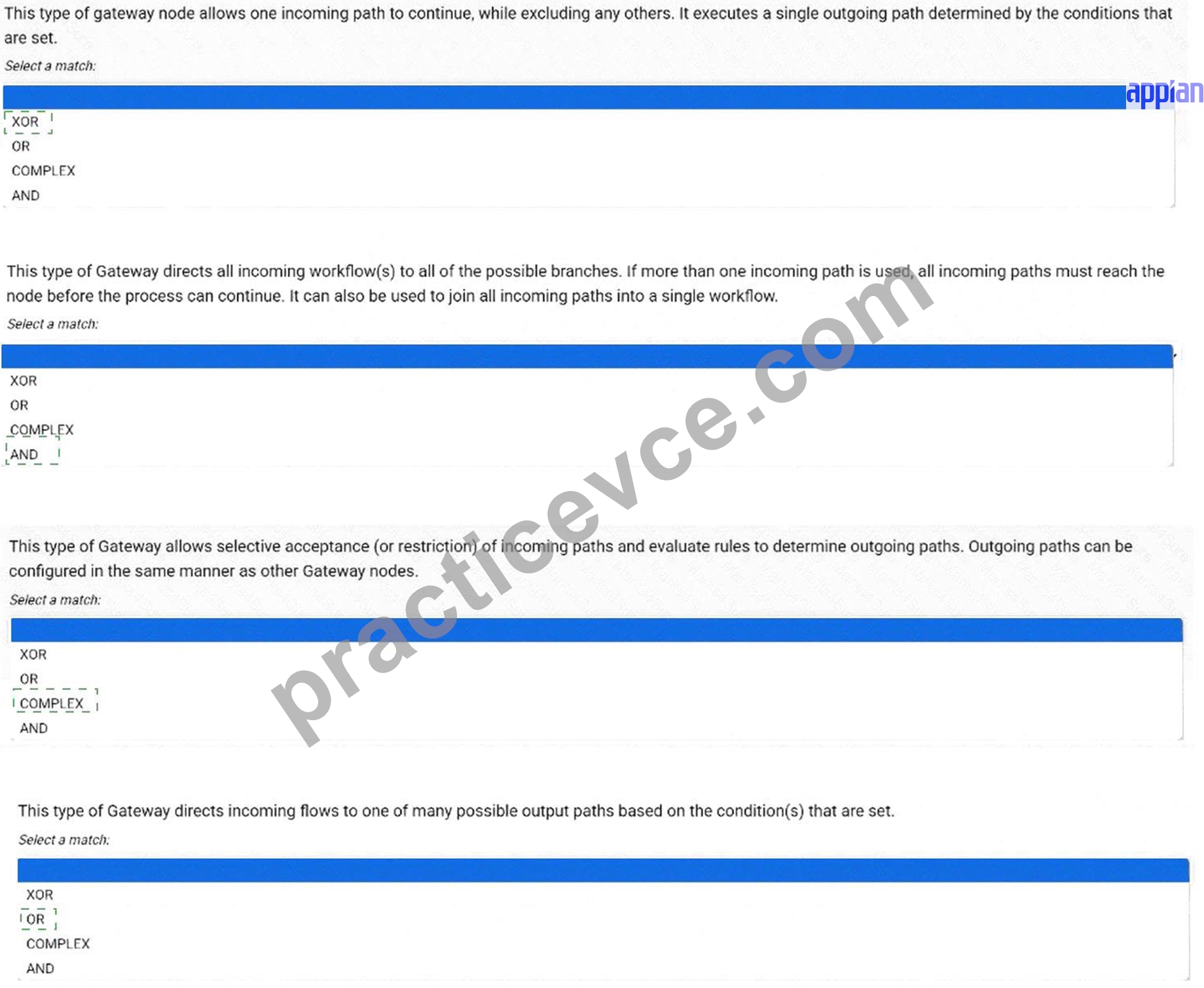
Explanation: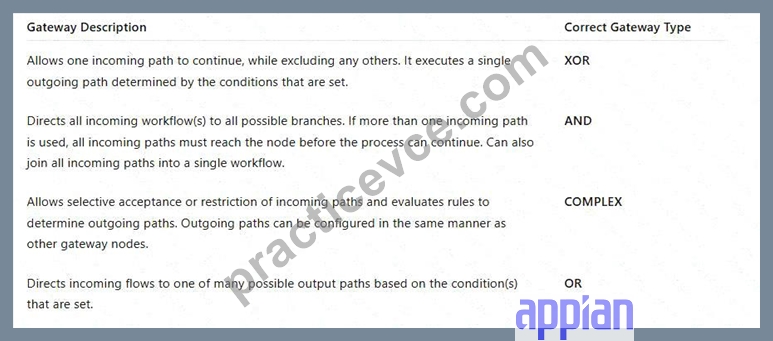
The key distinction is exclusivity versus parallelism versus selective control. XOR is the exclusive decision
/merge gateway: it permits only one path to proceed and chooses a single outgoing path based on configured conditions. AND is the parallel fork/join gateway: it sends workflow to all outgoing branches and, when used as a join, waits until all required incoming paths arrive before continuing. COMPLEX is used when normal XOR, OR, or AND behavior is insufficient; it can restrict or selectively accept incoming paths and then evaluate rules for outgoing routing. OR is the inclusive decision/merge gateway: it routes incoming flow to one of many possible output paths based on configured conditions. Appian's gateway documentation lists these descriptions directly under the Process Modeler gateway node types, including XOR, OR, COMPLEX, and AND behavior. Relevant exam topics: Process Modeling, Gateway Nodes, Workflow Routing, Decision/Merge Behavior, and Process Design Fundamentals .
NEW QUESTION # 57
You are part of an Agile team, and your responsibilities and attributes include:
A keen understanding of the business, the customer, and the market
The ability to clearly express product backlog items
The ability to prioritize the backlog to optimize the value of what the team will deliver The ability to order the items in the product backlog to best achieve goals and missions.
What is your role name?
- A. Scrum Master
- B. Appian Analyst
- C. Product Owner
- D. Sponsor
Answer: C
Explanation:
The responsibilities and attributes described are aligned with the role of a Product Owner in an Agile team.
The Product Owner is responsible for maximizing the value of the product resulting from the work of the development team. They have a deep understanding of the business, customer needs, and market trends, and they use this knowledge to manage and prioritize the product backlog.
* Role of Product Owner:
* Understanding the Business: The Product Owner must understand the business context to prioritize work that delivers the most value.
* Expressing Product Backlog Items: The Product Owner is responsible for defining and clearly expressing the items in the product backlog.
* Prioritizing and Ordering the Backlog: The Product Owner prioritizes and orders the backlog items to optimize the team's output and ensure alignment with business goals.
* Why Not Other Options?:
* A. Appian Analyst: While an Appian Analyst may have some similar responsibilities, the specific role of managing the product backlog and optimizing the value delivered by the team is the core responsibility of the Product Owner.
* B. Scrum Master: The Scrum Master facilitates the Scrum process but does not manage the product backlog.
* D. Sponsor: The Sponsor typically provides financial support and strategic direction but does not manage day-to-day product backlog activities.
* References:
* Appian Community Success Guide:Roles in Agile Teams
The Product Owner role is crucial in ensuring that the development team is working on the most valuable features and that the product aligns with business and market needs.
NEW QUESTION # 58
......
Everybody hopes he or she is a successful man or woman no matter in his or her social life or in his or her career. Thus owning an authorized and significant certificate is very important for them because it proves that he or she boosts practical abilities and profound knowledge in some certain area. Passing ACA100 Certification can help they be successful and if you are one of them please buy our ACA100 guide torrent because they can help you copyright easily and successfully.
Learning ACA100 Materials: https://www.practicevce.com/Appian/ACA100-practice-exam-dumps.html
- ACA100 Test King ???? Frenquent ACA100 Update ???? ACA100 New Test Bootcamp ???? Open ⏩ www.troytecdumps.com ⏪ and search for ➡ ACA100 ️⬅️ to download exam materials for free ????ACA100 Reliable Exam Materials
- Pass Guaranteed Quiz Perfect Appian - ACA100 Valid Practice Questions ???? Search for ➤ ACA100 ⮘ and download it for free on ▛ www.pdfvce.com ▟ website ????Latest ACA100 Mock Test
- Seeing The ACA100 Valid Practice Questions Means that You Have Passed Half of Appian Certified Analyst ???? Immediately open ⮆ www.troytecdumps.com ⮄ and search for ➠ ACA100 ???? to obtain a free download ????ACA100 Reliable Test Materials
- Practical ACA100 Information ???? Reliable ACA100 Test Simulator ???? Exam ACA100 Cram Questions ???? Search for ➠ ACA100 ???? and obtain a free download on 【 www.pdfvce.com 】 ????Review ACA100 Guide
- ACA100 Free Learning Cram ???? ACA100 New Test Bootcamp ???? ACA100 Exam Voucher ???? Search for ( ACA100 ) and download exam materials for free through ➥ www.examcollectionpass.com ???? ????ACA100 Reliable Exam Pass4sure
- 2026 High Hit-Rate 100% Free ACA100 – 100% Free Valid Practice Questions | Learning Appian Certified Analyst Materials ???? Go to website ⇛ www.pdfvce.com ⇚ open and search for ➥ ACA100 ???? to download for free ????ACA100 Free Learning Cram
- ACA100 Exam Voucher ???? ACA100 Reliable Exam Pass4sure ???? ACA100 Reliable Exam Pass4sure ???? Search for ▛ ACA100 ▟ and download it for free immediately on 【 www.pdfdumps.com 】 ????ACA100 Flexible Learning Mode
- Try a Free Demo and Then Buy Appian ACA100 Exam Dumps ???? The page for free download of ▛ ACA100 ▟ on 「 www.pdfvce.com 」 will open immediately ????ACA100 Test King
- Exam ACA100 Study Solutions ???? ACA100 New Test Bootcamp ???? Latest ACA100 Test Prep ✏ Search for ➽ ACA100 ???? and download it for free immediately on ⏩ www.practicevce.com ⏪ ⏪Practical ACA100 Information
- 2026 High Hit-Rate 100% Free ACA100 – 100% Free Valid Practice Questions | Learning Appian Certified Analyst Materials ???? Copy URL ⇛ www.pdfvce.com ⇚ open and search for ➡ ACA100 ️⬅️ to download for free ????ACA100 Reliable Exam Materials
- Pass Guaranteed Quiz 2026 ACA100: The Best Appian Certified Analyst Valid Practice Questions ???? Go to website ➤ www.examcollectionpass.com ⮘ open and search for ⮆ ACA100 ⮄ to download for free ????Review ACA100 Guide
- learn.csisafety.com.au, larissaunjh555464.wiki-racconti.com, bookmark-nation.com, mayalrwp679411.creacionblog.com, lorixuqr359120.yomoblog.com, todaybookmarks.com, myportal.utt.edu.tt, myportal.utt.edu.tt, myportal.utt.edu.tt, myportal.utt.edu.tt, myportal.utt.edu.tt, myportal.utt.edu.tt, myportal.utt.edu.tt, myportal.utt.edu.tt, myportal.utt.edu.tt, myportal.utt.edu.tt, bookmarkdistrict.com, bizdirectoryinfo.com, shaniaeqwi843883.iyublog.com, Disposable vapes
P.S. Free & New ACA100 dumps are available on Google Drive shared by PracticeVCE: https://drive.google.com/open?id=1dFYJEDtnhHtaaFqqgy58P-VLLJzbI_C9
Report this wiki page